
What Is Flexible Workspace and How Is It Different From a Traditional Lease?
If you've spent your career investing in multifamily, industrial, or retail, flexible workspace may look like a footnote in the office market. It's worth a closer look. Flex is one of the few parts of commercial real estate that has kept growing through the pandemic, the remote-work debate, and the most famous collapse in the industry's history. Understanding why starts with a simple question: what is a business actually buying when it chooses flex over a traditional lease?
What exactly counts as flexible workspace?
Flexible workspace is rentable office space a business can occupy on short, adaptable terms. These offices generally come fully furnished and ready to use.
Instead of signing a long lease for an empty floor that may or may not fill up with employees, a company pays a monthly fee for space an operator has already built out, equipped, and staffed.
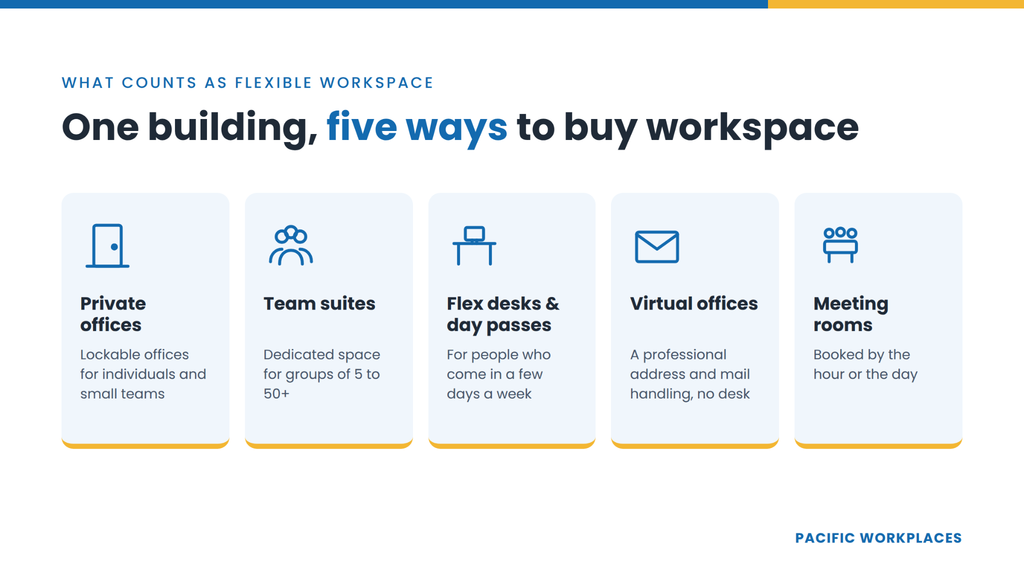
The category covers more than the open-plan coworking floor most people picture:
- Private offices with lockable doors for individuals and small teams
- Team suites for groups of 5 to 50 or more people
- Flex desks and day passes for people who come in a few days a week
- Virtual offices, which give a business a professional address and mail handling without a physical desk
- Meeting rooms booked by the hour or day
That range matters to investors. A flex operator isn't selling one product to one type of customer. It sells a menu of workspace services to freelancers, startups, law firms, and enterprise teams, often in the same building.
How does a traditional office lease work, and why are companies rethinking it?
A traditional office lease typically runs five to ten years. The tenant usually negotiates build-out costs, buys furniture and IT infrastructure, pays operating expenses on top of base rent, and often signs a personal or corporate guarantee. Once the lease is signed, the footprint is fixed. If the company grows, it runs out of room. If it shrinks, it keeps paying for empty desks.
That model made sense when headcount was predictable and everyone came in five days a week. Hybrid work broke that assumption.
Many large employers are now rethinking their footprints dramatically. Fortune 500 companies including Allstate and T-Mobile are cutting 60 to 80 percent of their traditional office space. Some of that demand disappears, but much of it moves into flexible arrangements that match how teams actually work now.
What's the real difference between flex space and a traditional lease?
| Traditional Lease | Flexible Workspace | |
|---|---|---|
| Term | Typically 5–10 years | Month-to-month to a few years |
| Upfront cost | Build-out, furniture, IT, deposits | Usually a deposit and first month |
| Move-in time | Months of negotiation and construction | Days |
| Scaling | Fixed footprint | Add or drop offices as headcount changes |
| What's included | Space only; tenant manages operations | Furniture, internet, reception, cleaning, meeting rooms |
| Risk to the business | Long-term liability on the balance sheet | Short-term, predictable operating expense |
The simplest way to think about it: a traditional lease sells square footage, while flexible workspace sells a service. The customer isn't buying space so much as buying the ability to never think about space.
Cost is often a factor too. One analysis found that renting shared workspace was significantly more affordable than leasing traditional office space in 96% of the cities studied, once the full cost of a conventional lease was counted.
Who is actually using flexible workspace today?
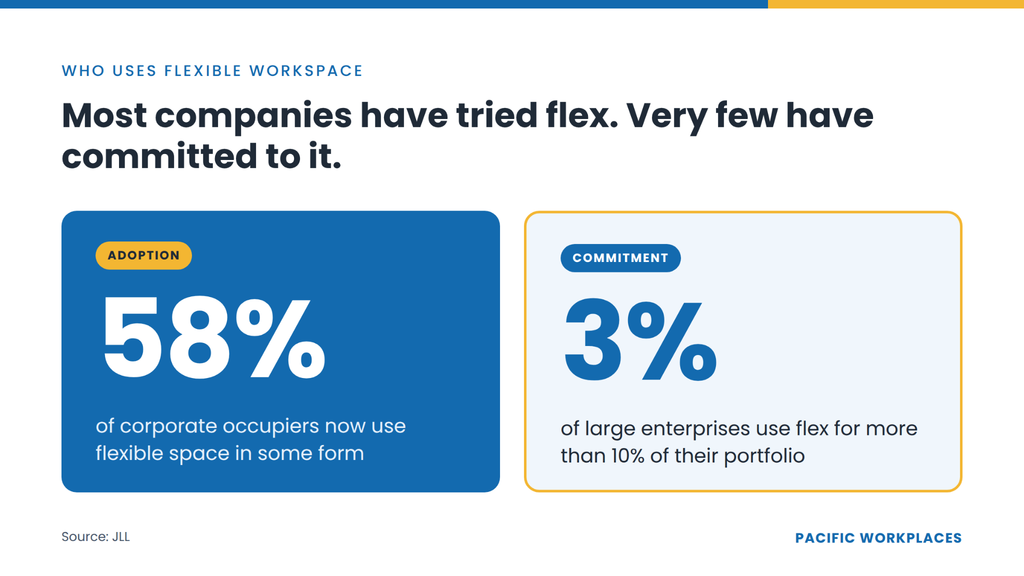
The early stereotype of coworking as freelancers and startups in hoodies is out of date. 58% of corporate occupiers now use flexible space in some form. Enterprises use it for regional teams, project groups, and employees who want an office closer to home than headquarters.
Even so, corporate adoption is shallow. JLL found that only 3% of large enterprises use flexible space for more than 10% of their portfolio, a gap the firm describes as a significant opportunity for occupiers, landlords, and investors. Put simply, most companies have started using flex, and very few have committed to it at scale.
Is flexible workspace growing, or is it still a niche?
It's still a small slice of the office market, and that's part of the growth story. According to Yardi Kube, flexible workspace made up 2.2% of total U.S. office inventory at the start of 2026, up from 2.0% a year earlier. The growth isn't limited to major downtowns either. Tertiary markets grew nearly 10% year over year as of Q2 2025, as flex follows workers into suburbs and mid-size cities.
The clearest signal may be who is buying in. Recent milestones include CBRE's full acquisition of Industrious in 2025, Convene's acquisition of NeueHouse in January 2026, and the acquisition of Vast Coworking by New State Capital Partners and Graycliff Partners in March 2026. When the world's largest commercial real estate services firm buys a flex operator outright, the category has moved from experiment to infrastructure.
How does flexible workspace hold up when the economy turns?
This is the question every investor should ask, and the answer surprises people. The logic of flex means demand can hold up in a downturn in ways a traditional office building's demand may not:
- Companies cutting costs often move into flex, not out of it. When a business needs to shed a long lease, a flexible office is often where it lands. The same uncertainty that empties traditional buildings can send new customers to flex operators.
- Revenue is spread across hundreds of small agreements. A traditional building may depend on a handful of large tenants. A flex operator's income comes from many members across many industries, so losing any one of them matters less.
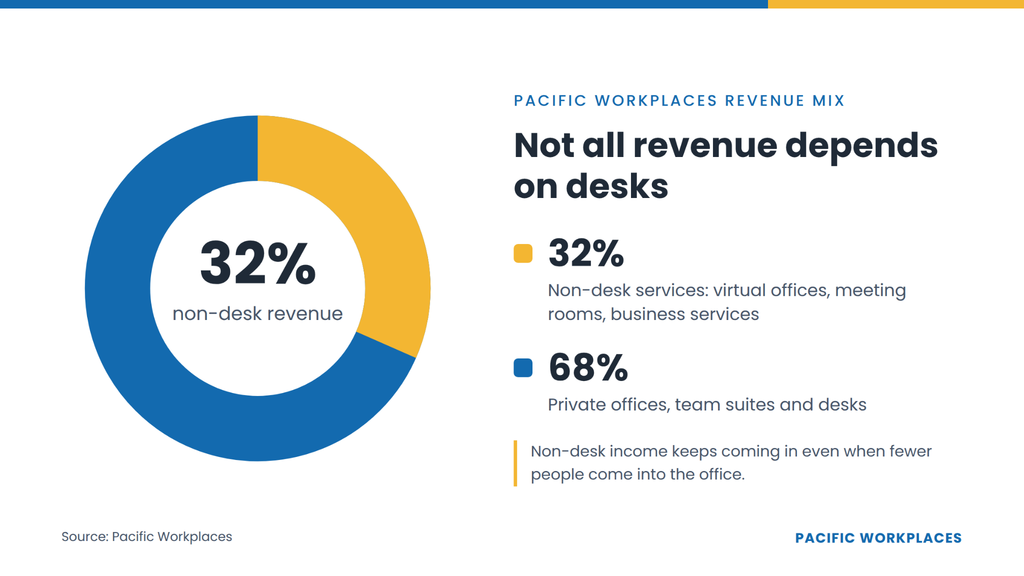
- Not all revenue depends on desks. Virtual offices, meeting rooms, and business services keep generating income even when fewer people come in. At Pacific Workplaces, 32% of revenue comes from non-desk services such as virtual offices and meeting rooms.
None of this makes flex immune to downturns. An operator that signs expensive leases at the top of the market, or grows faster than demand, can get into serious trouble. The industry learned that lesson very publicly.
WeWork Went Bankrupt in 2023. Why Is Flex Workspace Still Growing?
For many investors, WeWork is the first thing that comes to mind when they hear "coworking." Its story is worth understanding, because it's a story about one company's model, not the category's demand.
At its peak, WeWork was the most aggressive operator the industry had ever seen. By 2019, less than a decade after its founding, it operated 850 locations, fueled by a SoftBank investment that valued the company at $47 billion. It signed long, expensive leases at peak-market rents and priced memberships to grow rather than to profit. When the pandemic hit, it was carrying billions in rent obligations on locations that didn't pencil out.
The more important story is what happened to the rest of the industry. Experts said at the time that WeWork had unique problems with its business model, but that demand for flexible workspace would likely keep growing.
That's what happened.
During the first three months of 2025, the five largest coworking brands grew their national footprint by 6%, collectively operating more than 1,800 locations.
The lesson for investors isn't that flex is risky or safe. It's that operator discipline matters more than category hype. The operators that came through 2008, the pandemic, and the WeWork collapse tended to share a few traits: they grew at the pace of demand, signed leases they could afford in a bad year, and built revenue beyond desk rentals.
Pacific Workplaces has operated through each of those cycles over 23 years, and has been profitable through every one of them, including COVID. For more on how PAC's approach differs, see our customer ratings and pricing comparison with Regus and WeWork.
How do flexible workspace operators make money?
Most flex operators lease space from landlords, build it out, and rent it to members on flexible terms, earning the spread between the rent they pay and the revenue they generate. Others own their buildings, and some do both. Each structure carries different risks and return profiles, and confusing them is one of the most common mistakes new investors make.
Our Chief Growth Officer, Ben Wright, breaks down all three models, with real operators as case studies, in OpCos, PropCos, or Both? How Investors Should Think About Flexible Workspace Capital Structures.
Where can I learn more about investing in flexible workspace?
If you're new to the category, start with our Investors page, where CEO Laurent Dhollande and Ben Wright discuss 23 years of operating history and why hybrid work reshaped office real estate. To understand what a position in a flex operator involves, read What Does a $100K Investment in a Flexible Workspace Operator Actually Buy You?
Accredited investors interested in Pacific Workplaces' current raise can learn more about Pacific Workplaces Fund A or contact Ben Wright at Ben@PacificWorkplaces.com to begin accredited investor verification.
This article is for informational purposes only. It is not investment advice and is not an offer to sell or a solicitation to buy any security. Any references to specific companies are illustrative. Any offering of Pacific Workplaces Fund A will be made only to accredited investors pursuant to a Private Placement Memorandum under Rule 506(c) of Regulation D.
Sourcing: The 32% non-desk revenue and "profitable through every cycle" figures come from Ben's OpCo/PropCo post. Market stats come from Yardi Kube, JLL, Coworks, Commercial Property Executive, Bisnow, Governing, and CoworkingCafe; add outbound source links as preferred.